



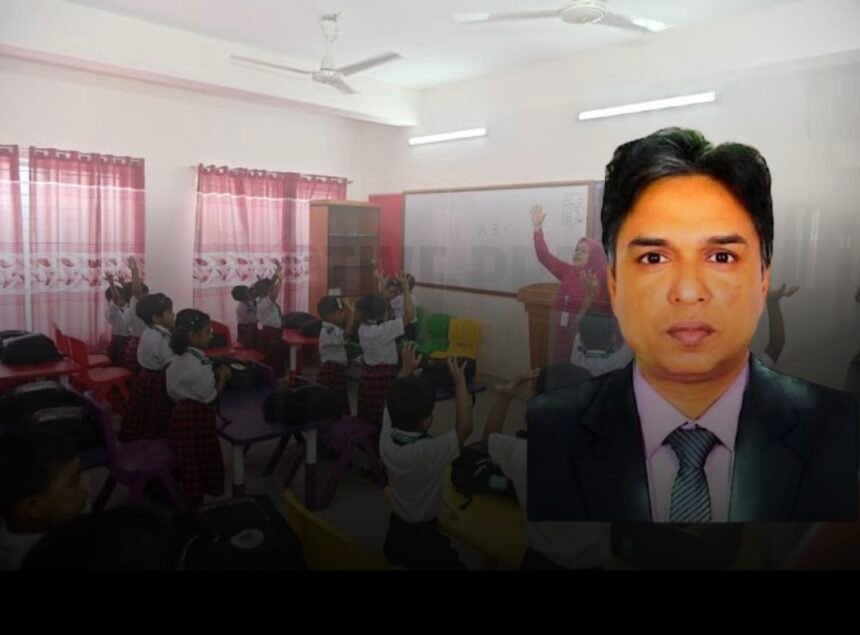
Professor Badrul Islam: In the landscape of Bangladesh’s education sector, the shift from competitive admission tests to a lottery system for primary and secondary levels marks one of the most pro-student and humane decisions in recent history. As certain vested interest groups and business circles lobby for the return of admission exams, it is crucial to understand why a lottery-based system is not just an administrative choice, but a scientific and moral necessity.
The Psychological Toll of “Winning and Losing” Competitive exams for children aged 9 to 12 are inherently flawed. Psychologically, this age group is ill-equipped to handle the crushing weight of “failure.” When a child is rejected from a “reputed” school, the sense of inadequacy can lead to long-term depression and a permanent loss of self-confidence.
Admission tests force children into a culture of rote memorization, killing their natural curiosity. Instead of exploring arts, sports, or storytelling, their childhood is confined to the four walls of coaching centers. Furthermore, this process is an invisible prison for mothers, who often face extreme social and psychological pressure to secure their child a spot in a “top-tier” institution. The lottery system liberates both mother and child from this mental cage.
Dismantling the Coaching Commerce For decades, a multi-billion taka “admission coaching” industry has thrived on the fear of parents. These “Education Mafias” profit by destroying creativity and promoting a narrow, exam-centric mindset.
A return to admission tests would be a self-destructive move, revitalizing these dishonest cartels and placing an immense financial burden on middle- and lower-income families. By maintaining the lottery system, we ensure that education remains a right, not a commodity sold by coaching tycoons.
Inclusivity and Social Revolution The lottery system is a silent revolution in social equality. In an admission test scenario, children from wealthy families hold an unfair advantage through expensive tutors and guidebooks.
The lottery creates a level playing field where the child of a rickshaw puller and the child of a high-ranking official have the same opportunity. This “Inclusive Education” allows students of mixed abilities to grow together. Brighter students learn empathy and leadership by helping their peers, while those struggling find inspiration and discipline from their classmates.
Global Standards and Scientific Reality Looking at global leaders in education—Finland, Japan, and Singapore—we see a common thread: no competitive admission tests at the primary or lower-secondary levels. In Finland, there are no “elite” schools; every neighborhood school offers the same quality of education.
International bodies like UNESCO and UNICEF have repeatedly warned that over-testing children stifles creative thinking. Testing a 10-year-old’s entire future based on a one-hour exam is scientifically unsound. A child’s merit should be evaluated through continuous assessment in the classroom, not at the entry gate.
The Way Forward The challenge for the state is now to ensure that the quality of education is standardized across all schools. To pull parents away from the obsession with “big-name” schools, we must invest in skilled teachers and modern infrastructure for every neighborhood institution.
Education is not a product, and our children are not racehorses. We must not succumb to the pressure of business interests. Keeping the lottery system up to Class VI is a humanitarian imperative. To ensure a creative and joyful future for our children, there is simply no alternative to the lottery.